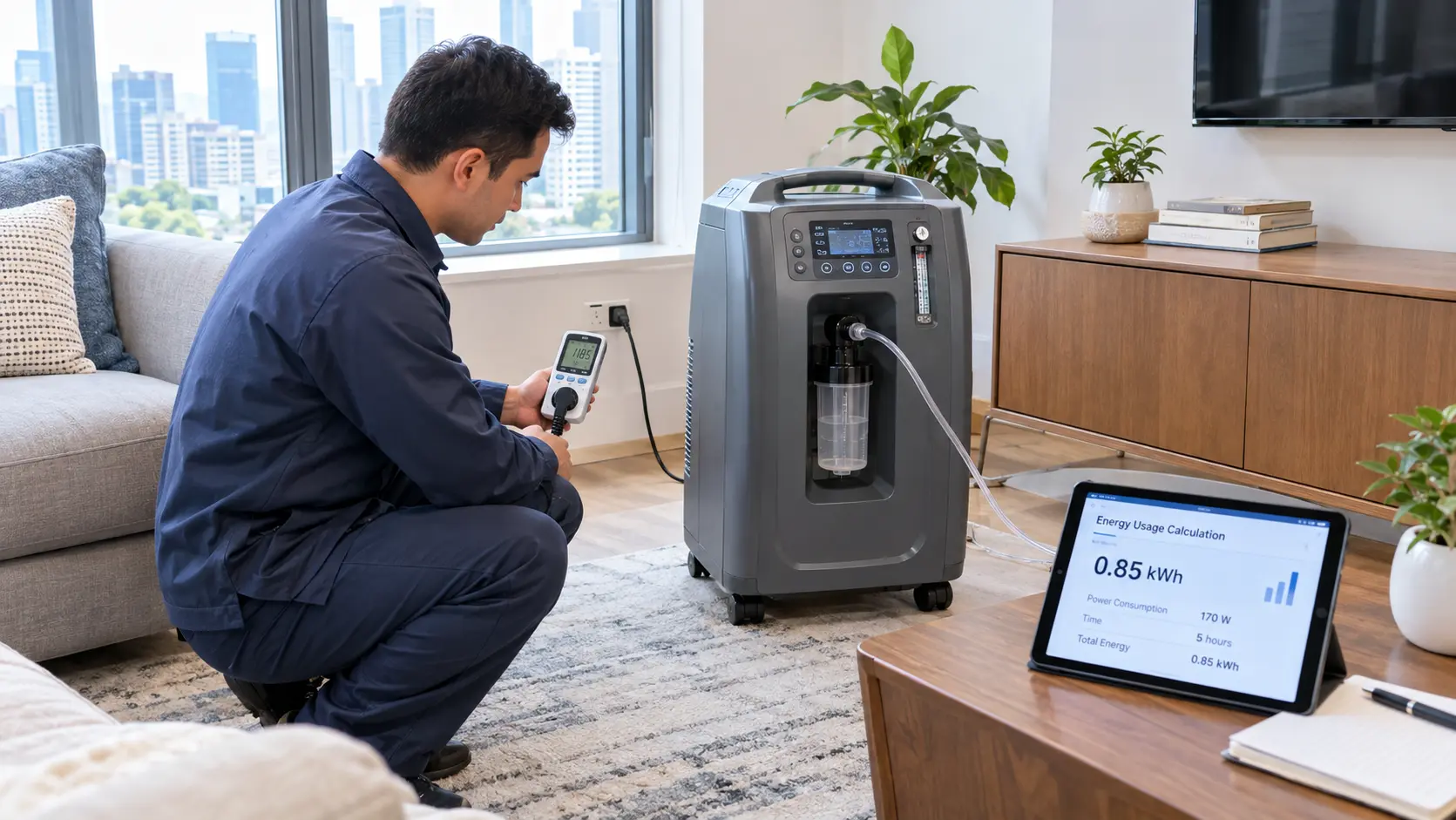
5L oxygen concentrator electricity use depends on the machine’s power rating, operating hours, and equipment design. A stationary five-liter oxygen concentrator typically consumes several hundred watts of electrical power while producing oxygen-enriched gas for prescribed home oxygen therapy.
For example, a concentrator consuming 300 watts continuously would use approximately 7.2 kilowatt-hours (kWh) of electricity in 24 hours. Over 30 days, that would equal approximately 216 kWh.
However, this is an illustrative calculation rather than a universal specification. Actual consumption varies between models, and buyers should use the manufacturer’s published power rating when estimating electricity costs.
Understanding watts, kilowatt-hours, and local electricity tariffs makes it easier to calculate the potential operating expenses of home oxygen equipment.
Understanding 5L Oxygen Concentrator Electricity Use
A five-liter oxygen concentrator is generally designed to provide continuous-flow oxygen-enriched gas at adjustable settings up to five liters per minute.
The machine requires electricity to operate its compressor, internal valves, cooling components, and electronic monitoring systems.
Unlike compressed oxygen cylinders, a stationary concentrator produces oxygen-enriched gas from surrounding air while connected to an appropriate electrical supply.
Therefore, electricity consumption becomes an important consideration when the equipment operates for extended periods.
What Does the Wattage Rating Mean?
Watts measure the rate at which electrical energy is consumed.
For example, a device rated at 300 watts uses electrical power at a rate of 300 watts while operating under the conditions represented by that rating.
However, the published rating may represent nominal, maximum, or another specified operating condition.
Consequently, buyers should check how the manufacturer defines the stated wattage.
What Is a Kilowatt-Hour?
A kilowatt-hour measures electrical energy consumption over time.
One kilowatt-hour equals the energy used by a 1,000-watt device operating for one hour.
Electricity providers commonly use kilowatt-hours when calculating household energy charges.
This makes kWh the most useful measurement for estimating the operating cost of an oxygen concentrator.
How to Calculate Oxygen Concentrator Electricity Costs
Calculating electricity consumption requires three pieces of information:
- The concentrator’s power consumption in watts.
- The number of hours it operates.
- The applicable electricity price per kWh.
The basic calculation is:
Electricity consumption (kWh) = Power (watts) ÷ 1,000 × Operating hours
For example, consider a concentrator consuming 300 watts.
If it operates for eight hours:
300 ÷ 1,000 × 8 = 2.4 kWh
If it operates continuously for 24 hours:
300 ÷ 1,000 × 24 = 7.2 kWh
To estimate electricity expenses, multiply the calculated kWh by the applicable electricity tariff.
Example of Daily and Monthly Electricity Consumption
The following table illustrates electricity consumption at different hypothetical power levels.
| Power Consumption | 8 Hours Daily | 24 Hours Daily | 30 Days at 24 Hours Daily |
|---|---|---|---|
| 250 watts | 2.0 kWh | 6.0 kWh | 180 kWh |
| 300 watts | 2.4 kWh | 7.2 kWh | 216 kWh |
| 350 watts | 2.8 kWh | 8.4 kWh | 252 kWh |
| 400 watts | 3.2 kWh | 9.6 kWh | 288 kWh |
These figures are mathematical examples, not verified specifications for particular concentrator models.
Actual energy consumption should be calculated using the manufacturer’s equipment data or an appropriate measurement.
Checking the Power Requirements of a 5L Concentrator
Before purchasing equipment, review the exact model’s electrical specifications.
For example, the Drive DeVilbiss 525KS is a stationary five-liter continuous-flow oxygen concentrator manufactured by Drive DeVilbiss Healthcare.
When evaluating this or another model, buyers should consult the manufacturer’s documentation for its specified power consumption, voltage, frequency, and electrical safety requirements.
The 525KS is designed for an appropriate 220–230V, 50Hz electrical supply.
However, buyers should confirm the exact regional model and its electrical requirements before installation.
Power specifications should never be estimated solely from the machine’s maximum oxygen flow rate.
What Factors Affect Oxygen Concentrator Electricity Consumption?
Several factors can influence the electricity used by a stationary concentrator.
Equipment Design
Different manufacturers use different compressors, cooling systems, and internal components.
As a result, two concentrators with the same maximum oxygen flow capacity may have different power requirements.
Operating Hours
The number of operating hours has a direct effect on total energy consumption.
A concentrator used for 24 hours generally consumes more electricity than the same machine used for eight hours under comparable conditions.
However, operating schedules must follow medical instructions rather than electricity-saving preferences.
Flow Settings
Some concentrators may consume different amounts of electricity at different operating settings.
Nevertheless, the relationship between oxygen flow and electrical consumption varies by model.
A lower flow setting does not necessarily produce a proportional reduction in electricity use.
Maintenance and Operating Conditions
Proper maintenance supports reliable equipment operation.
Blocked ventilation, dirty filters, or mechanical problems may interfere with normal performance.
However, users should not assume that cleaning a filter will produce a particular percentage reduction in electricity costs.
Always follow the manufacturer’s maintenance instructions.
Can You Reduce Oxygen Concentrator Electricity Costs?
The safest approach is to select clinically appropriate equipment with suitable electrical specifications.
Buyers can compare manufacturer-published power ratings when evaluating different concentrators.
Additionally, keeping ventilation openings clear and maintaining equipment according to the manufacturer’s instructions supports normal operation.
However, users should never reduce prescribed oxygen flow, shorten prescribed treatment hours, or switch off necessary equipment solely to save electricity.
Oxygen therapy settings must remain under the direction of a qualified healthcare professional.
Does a 5L Oxygen Concentrator Need Backup Power?
Most stationary oxygen concentrators depend on a continuous electrical supply and do not contain a built-in battery capable of sustaining normal operation during an outage.
Therefore, people who require uninterrupted oxygen therapy should discuss appropriate backup arrangements with their healthcare team and equipment provider.
Backup solutions may involve suitable alternative oxygen equipment or another professionally approved arrangement.
Any external power system must meet the concentrator’s electrical requirements.
Users should not connect medical oxygen equipment to an unverified inverter, generator, or battery system without confirming compatibility and safety.
Is Running a 5L Oxygen Concentrator Expensive?
Operating costs depend on the concentrator’s actual wattage, daily operating time, and local electricity tariff.
For example, a hypothetical 300-watt concentrator operating continuously for 30 days consumes approximately 216 kWh.
If electricity costs HK$1.50 per kWh, the estimated energy charge would be HK$324.
However, this is only an illustrative calculation. Actual Hong Kong electricity charges depend on the applicable tariff structure, adjustments, and household billing conditions.
Furthermore, electricity costs represent only one component of equipment ownership. Replacement accessories, maintenance, and servicing may create additional expenses.
Final Thoughts
Understanding 5L oxygen concentrator electricity use helps households estimate the long-term operating expenses of prescribed oxygen equipment.
The most reliable calculation starts with the manufacturer’s specified power consumption, converts watts into kilowatt-hours, and applies the relevant electricity tariff.
Although equipment efficiency and operating costs deserve consideration, clinical suitability and reliable oxygen delivery remain the priorities.
By comparing verified electrical specifications and following proper operating instructions, buyers can make informed decisions without compromising essential oxygen therapy requirements.