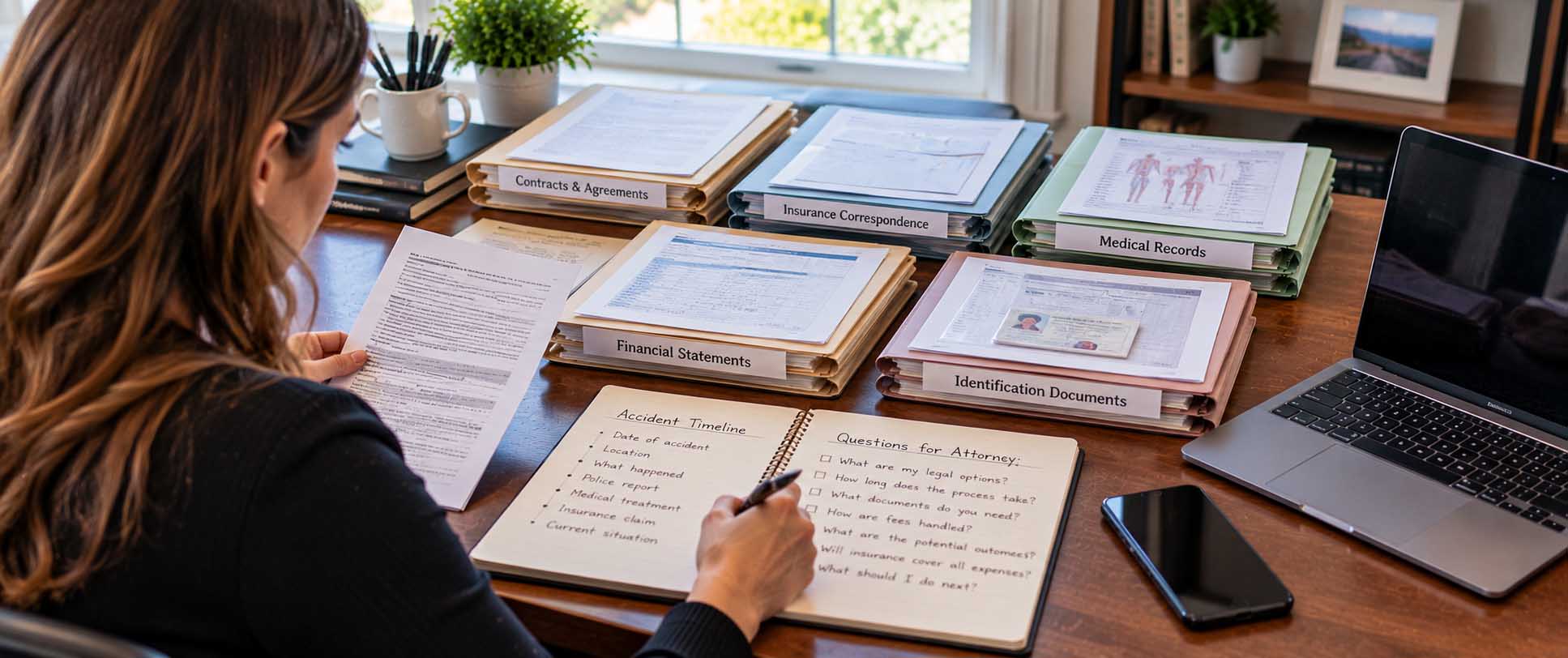
Preparing the right documents for legal consultation can help an attorney understand a legal problem more efficiently. Relevant records may include contracts, written correspondence, financial statements, medical documentation, insurance information, and a timeline of important events.
However, the exact documents depend on the legal matter. Someone seeking advice after an automobile accident may need different records than a person involved in a property dispute.
Organizing available information before contacting an attorney can make the initial discussion more productive. Clients do not need to understand every legal issue or collect every possible record before seeking advice.
Why Documents for Legal Consultation Matter
Attorneys often need to establish what happened, when it happened, and which individuals or organizations were involved. Supporting documents can help clarify these details.
For example, a written agreement may identify contractual obligations, while an insurance letter may explain why an insurance company denied a claim.
In addition, dated records can help an attorney identify potential deadlines and determine whether further investigation is necessary.
Nevertheless, missing paperwork should not prevent someone from seeking legal guidance, particularly when an important deadline may be approaching.
Essential Documents for Legal Consultation
Although every situation differs, several categories of records are commonly useful. These documents can help an attorney understand the circumstances and identify questions requiring further review.
Identification and Contact Information for Legal Advice
Prospective clients should prepare their full name, current contact details, and the names of other parties involved.
An attorney may request identification when necessary for client verification or administrative purposes.
However, clients should share sensitive personal documents only through an appropriate, secure process.
Contracts and Written Agreements for Attorney Review
Contracts can be important in business, employment, property, and other legal matters.
Relevant documents may include:
- Signed agreements and amendments
- Purchase or service contracts
- Lease agreements
- Employment-related documents
- Written notices concerning disputed obligations
Whenever possible, retain complete copies rather than isolated pages. This helps preserve the surrounding terms and conditions.
Emails, Letters, and Legal Correspondence
Written communication can establish what different parties said and when particular discussions occurred.
For example, emails may show attempts to resolve a disagreement before legal action became necessary.
Similarly, text messages may contain relevant dates, acknowledgments, or requests.
Preserve original communications where possible, including dates, sender information, and attachments. Avoid altering messages or deleting material that may be relevant.
Documents for Legal Consultation After an Accident
Individuals seeking legal guidance after an accident may benefit from organizing incident-related records.
These can include police reports, photographs, insurance correspondence, and medical documentation.
Medical Records for a Personal Injury Consultation
Medical documentation may help establish the nature of reported injuries and the treatment received.
Useful records can include discharge instructions, treatment summaries, prescriptions, and medical bills.
In addition, a list of healthcare providers and appointment dates can help an attorney understand the treatment history.
However, clients should not delay necessary medical care while collecting legal paperwork.
Accident Reports and Supporting Photographs
An incident report may contain information about the location, date, and circumstances of an accident.
Photographs can also help preserve details that may change over time.
For example, images of vehicle damage or hazardous property conditions may provide useful context.
If the original report is unavailable, record the reporting agency and any available reference number.
Preparing Legal Consultation Documents Before Meeting an Attorney
Prospective clients should review a firm’s practice areas before requesting a consultation.
For example, Long Island residents considering Siben & Siben’s free initial consultation can review the firm’s published legal services and contact information before asking which records may be relevant to their situation.
The firm is located in Bay Shore, Suffolk County, New York.
However, clients should confirm current consultation availability, applicable terms, and document-submission procedures directly with the office.
Different legal matters may require different preparation.
How to Create a Timeline for Legal Consultation
A timeline can help connect documents to the events they describe.
First, identify the earliest relevant event. Then, continue in chronological order.
For each entry, record the approximate date, what happened, who was involved, and any supporting documentation.
For example, a property dispute timeline might include the agreement date, payment history, reported problems, and subsequent correspondence.
If a date is uncertain, identify it as an estimate rather than presenting it as confirmed.
As a result, the attorney can more easily distinguish documented facts from personal recollections.
How to Organize Documents for Legal Consultation
A simple filing system is usually sufficient for managing legal records.
Create separate folders for agreements, correspondence, financial records, photographs, and other relevant material.
For digital documents, use descriptive filenames that include dates when appropriate.
For example, a filename identifying an insurance letter and its date is easier to locate than a generic scanned-document name.
In addition, preserve original files and maintain secure backup copies.
Avoid sending highly sensitive information through unsecured channels without first confirming the attorney’s preferred submission method.
What If Important Legal Documents Are Missing?
Missing records do not necessarily prevent an attorney from evaluating a legal issue.
Instead, prepare a list identifying what is unavailable and where the information might be obtained.
For example, a client may know that an insurance company issued a letter but no longer possess a copy.
The attorney can then explain whether obtaining that document would be useful.
However, clients should never create replacement records that others might mistake for originals.
Accurate explanations about missing information are more useful than reconstructed documents presented as authentic.
Questions to Prepare for Your Legal Consultation
In addition to organizing records, write down the main questions you want answered.
These may include:
- What legal options might apply to my situation?
- Are there deadlines I should know about?
- Which documents are most important?
- What additional information may be needed?
- How are legal fees and expenses handled?
- What should I avoid doing while the attorney evaluates the matter?
Having these questions ready can help keep the discussion focused.
For additional general information about New York legal procedures, prospective clients can consult the New York State Unified Court System’s CourtHelp resource.
However, general court information cannot replace advice from an attorney who understands the specific circumstances.
Final Checklist for Your Attorney Consultation
Organizing documents for legal consultation helps prospective clients present their circumstances clearly and identify information that may require further review.
Before meeting an attorney, review the records you have collected. Confirm that important correspondence, agreements, and supporting materials are accessible.
Next, organize the documents chronologically when possible and identify any missing information.
Finally, prepare a short list of questions about your legal concerns, possible deadlines, and next steps.
However, preparation does not require collecting every possible document before contacting an attorney.
For individuals seeking legal advice on Long Island or elsewhere in New York, gathering available records, preserving original information, and preparing clear questions can support a more effective initial consultation.