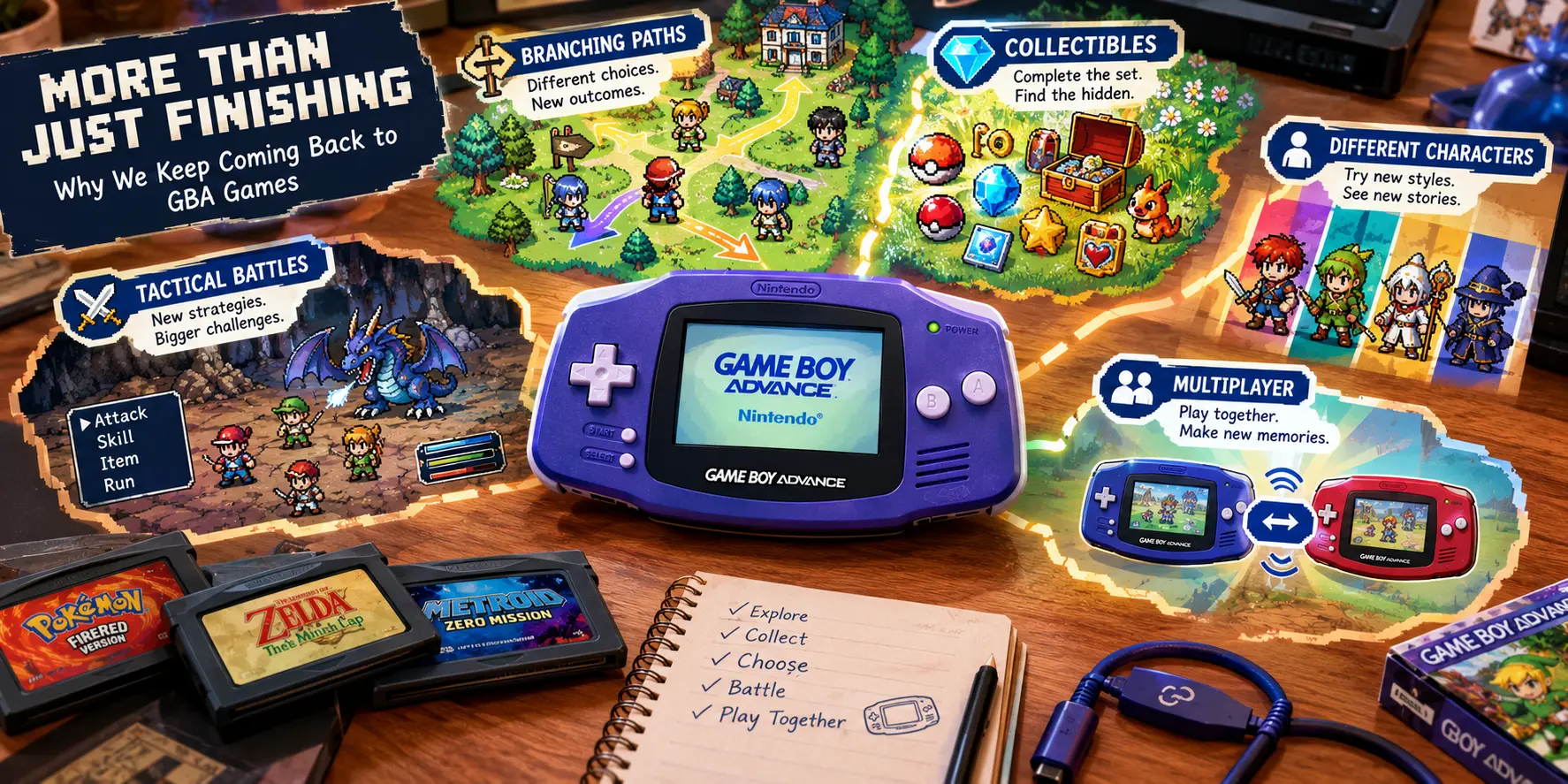
GBA games with replay value give players meaningful reasons to return after their first playthrough or initial hours of gameplay. Strong replayability can come from collectibles, optional challenges, different strategies, team building, multiplayer competition, post-game activities, or simply mechanics that remain satisfying after the main objectives are complete.
Replay value does not mean a game needs endless content. Instead, it means another session or playthrough can offer a worthwhile experience rather than feeling like an exact repetition of the first.
What Does Replay Value Mean in Retro Games?
Replay value describes how strongly a game encourages players to return after they already understand its main content.
For some games, that means beginning the entire adventure again and making different choices. For others, replayability comes from continuing an existing save to find collectibles, improve performance, complete optional challenges, or experiment with new strategies.
Retro handheld games can also create replay value through simple mechanics.
A racing game does not need a large story to remain replayable if improving lap times and competing against opponents continues to feel rewarding. Likewise, a strategy game can remain interesting because the same basic rules produce different situations depending on the player’s decisions.
GBA Games With Replay Value Offer More Than One Goal
One of the strongest forms of replayability comes from giving players goals beyond simply reaching the ending.
Collectibles are a common example.GBA games with replay value A player may complete the main journey without finding every optional item, secret area, or additional objective.
Character and team development can create another reason to continue.
Pokémon demonstrates this particularly well. Completing the main adventure is only one possible goal. Players can catch different Pokémon, experiment with team combinations, train particular creatures, explore optional content, and develop different battle strategies.
The important point is choice. When players can create new goals for themselves, the experience does not necessarily end when the primary objective is complete.
Strategic Variety Makes Repeat Playthroughs Feel Different
Games with meaningful strategic decisions often have natural replay value because players can approach familiar challenges differently.
Advance Wars is a good example.
Unit selection, positioning, terrain, resource management, and tactical priorities can change how a battle develops. A player who understands the basic mechanics can return and experiment with more efficient or completely different approaches.
This differs from replayability based on hidden content.
Instead of asking, “What did I miss?” strategy-based replay asks, “Could I solve this differently?”
That distinction can keep a game engaging even when players already know its maps, rules, and objectives.
Progression Can Encourage Players to Keep Returning
Progression is another major part of replayability.
Players generally want their actions to lead somewhere. Unlocking abilities, strengthening characters, improving a team, discovering equipment, or opening new areas can create a clear sense of forward movement.
However, progression works best when it changes what players can actually do.
A new ability that opens another exploration route can feel more meaningful than a simple numerical increase. Likewise, developing a different Pokémon team can change battle strategies rather than merely increasing power.
Players exploring GBA games worth playing can therefore consider replayability alongside genre, difficulty, gameplay, and overall design when deciding which titles deserve more of their time.
Multiplayer Can Extend a Game Beyond Solo Content
Multiplayer can create replay value without requiring developers to build an enormous amount of additional single-player content.
Human opponents behave differently from computer-controlled ones. Therefore, the same rules can produce new situations each time people play together.
Pokémon is an obvious example because trading and battling add social elements beyond the individual adventure.
Racing and competitive games can benefit in a similar way. A familiar course becomes less predictable when the challenge comes from another player’s decisions rather than a fixed sequence.
The Game Boy Advance Link Cable also made multiplayer an important part of certain GBA experiences.
Although access to original multiplayer setups may vary for modern retro players, multiplayer remains part of understanding why some games had particularly strong longevity.
Collectibles Give Completion-Focused Players Extra Goals
Some players enjoy reaching the ending. Others want to find everything.
Collectibles provide an additional layer of engagement for players who enjoy completion.
They can encourage closer exploration, reward curiosity, and give players reasons to revisit areas they previously passed through quickly.
However, collectibles create meaningful replay value only when finding them feels worthwhile.
If collecting becomes repetitive or disconnected from the main gameplay, it can feel like extra work rather than an enjoyable objective.
Strong collectible systems usually support exploration, progression, discovery, or mastery instead of existing solely to increase playtime.
Short Sessions Can Increase Long-Term Replayability
A game does not need to be a massive adventure to have lasting value.
In fact, games that work well in short sessions can become highly replayable because returning requires little commitment.
A player might complete a race, attempt a challenge, replay a level, fight a battle, or improve a previous result within a relatively short period.
This structure suits handheld gaming especially well.
Portable systems are often used in situations where players do not want to begin a lengthy sequence. Games with clear short-term objectives make it easier to pick up the system, accomplish something, and stop at a natural point.
Over time, those small sessions can produce considerable replay value.
Does a Longer Game Automatically Have More Replay Value?
No. Game length and replay value describe different things.
A game can take many hours to complete but offer little motivation for another playthrough. Conversely, a short racing, puzzle, action, or strategy game may encourage repeated sessions because its mechanics remain enjoyable.
Replayability depends more on what changes or remains engaging when players return.
Useful questions include:
- Can players try different strategies?
- Are there optional challenges or discoveries?
- Does skill improvement change the experience?
- Can players create different teams or builds?
- Is multiplayer available?
- Are the core mechanics enjoyable enough to repeat?
A game does not need all these qualities. Even one strong source of replayability can significantly increase its long-term appeal.
Strong Core Gameplay Is Still the Most Important Factor
Extra modes, collectibles, progression systems, and unlockables can encourage repeat play, but they cannot fully compensate for weak core gameplay.
Players are more likely to revisit a game when its basic actions remain enjoyable.
That might mean planning a tactical move in Advance Wars, experimenting with a Pokémon team, improving performance in a racing game, exploring an environment, or mastering a difficult section.
When the main gameplay loop remains satisfying, additional systems strengthen an already solid foundation.
When the foundation is weak, adding more objectives may simply give players more repetitive tasks.
Why Replay Value Matters for Retro Handheld Games
Retro players have enormous libraries of old and new games competing for their attention. A title that continues to provide enjoyable experiences after its first completion has a clear advantage.
Strong GBA games with replay value create that longevity in different ways. Some rely on collectibles and optional content. Others use strategic depth, multiplayer, progression, team building, skill mastery, or short repeatable challenges.
The most effective replayability gives players a genuine reason to return rather than merely asking them to repeat the same content. When another session can produce a new decision, discovery, strategy, achievement, or enjoyable challenge, a retro handheld game can remain rewarding long after its first playthrough.