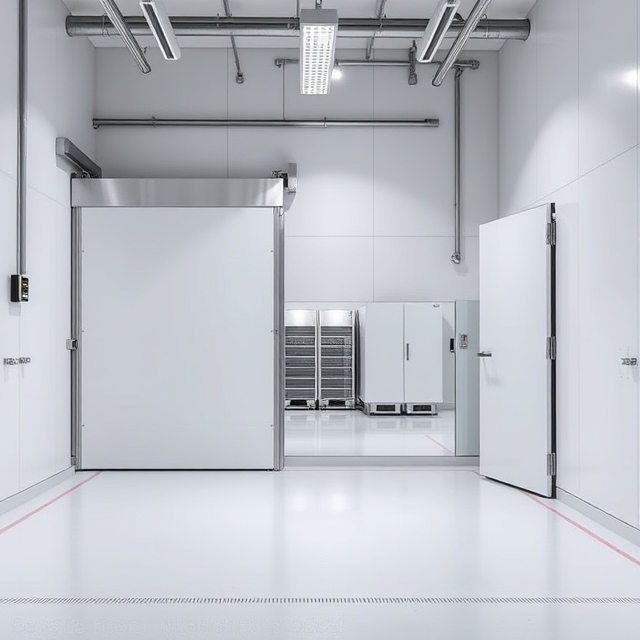
Choosing between sliding vs hinged cold room doors depends on how a refrigerated facility is used. Both designs can provide controlled access to a cold room or freezer, but they differ in how they occupy space, handle traffic, open, close, and integrate with the surrounding layout.
The right choice is therefore not simply about whether one door type is universally better. Facilities should consider available space, doorway dimensions, traffic frequency, insulation, sealing, temperature conditions, and the way people and equipment move through the opening.
How Do Sliding and Hinged Cold-Room Doors Differ?
A hinged cold-room door opens by swinging around hinges attached to one side of the frame. Depending on the configuration, the door leaf moves into or out of the room and requires sufficient clearance for its swing.
A sliding cold-room door moves horizontally along a track. Instead of occupying the space directly in front of the opening while it opens, the door travels alongside the wall or into a designated door pocket.
This basic difference can have a significant effect on facility layout.
For example, a hinged door may be practical where there is plenty of clearance in front of the opening and traffic is relatively light. A sliding design can be useful where a large opening is required or where the door swing would interfere with forklifts, pallet staging, racks, or pedestrian movement.
Space Around the Doorway
Available space is one of the first factors to examine.
A hinged door needs room for its leaf to move through its opening arc. If pallets, equipment, or another access route is located close to the doorway, that movement can become inconvenient.
Sliding doors generally avoid this swing area. However, they need suitable wall or side space for the door panel and its operating hardware.
The important question is not simply how much floor space is available. Facilities should examine both floor clearance and wall clearance.
A layout with limited aisle space may favor a sliding arrangement, while a location with restricted wall space may make a hinged configuration easier to accommodate.
Traffic Frequency and Material Handling
Traffic volume can change the practical requirements of a cold-room entrance.
A personnel door used occasionally does not face the same operating demands as an opening used repeatedly by forklifts or pallet trucks.
When vehicles regularly pass through the opening, operators need sufficient clearance and an access arrangement that does not interfere with maneuvering. Door operation should also fit naturally into the movement pattern.
For larger refrigerated openings and frequent material movement, cold room sliding doors can be considered where a horizontal opening system fits the facility layout and access requirements.
A hinged door may still work for equipment traffic when correctly sized and positioned, but its swing area must remain clear. If that space regularly becomes occupied by pallets or other equipment, the doorway can become difficult to use.
Insulation and Sealing Matter for Both Types
The difference between sliding and hinged construction does not eliminate the need for good thermal performance.
A cold-room door forms part of the separation between a controlled-temperature environment and a warmer surrounding area. Its construction should therefore limit unwanted heat transfer and air leakage when closed.
Important features can include:
- Insulated door panels
- Continuous or appropriate perimeter seals
- Properly fitted frames
- Suitable gaskets
- Correct alignment
- Durable hardware
- Appropriate materials for the operating environment
The sealing arrangement is especially important around the edges of the door. Gaps caused by poor installation, damaged seals, or misalignment can allow air exchange even when the door appears closed.
For freezer applications, the design should also account for moisture, condensation, and potential frost accumulation around the doorway.
Door Opening Geometry
Opening geometry is another important consideration.
A hinged door has a defined swing path. That path needs to remain free of obstructions whenever the door operates.
A sliding door uses horizontal movement, which can make it easier to maintain an unobstructed passage immediately in front of the opening. However, the side of the doorway must provide adequate space for the moving panel and its track system.
Facilities should consider the complete geometry rather than looking only at the rough opening dimensions.
Ask:
- Where will the door move when opening?
- Will it interfere with racks or equipment?
- Is there enough clearance for the largest vehicle?
- Can workers see approaching traffic?
- Is there enough wall space for a sliding panel?
- Will another door or access route conflict with its movement?
These questions are particularly important during the design stage because changing the surrounding layout after installation can be difficult.
Sliding vs Hinged Cold Room Doors for Different Applications
There is no single configuration that suits every cold-storage environment.
Smaller Personnel Access
A hinged door may be suitable for a smaller cold room where people enter occasionally and there is adequate swing clearance.
Its straightforward operating movement can work well for low-volume access.
Large Cold-Room Openings
A sliding arrangement may be considered when the facility requires a larger access opening and wants to avoid a large door leaf swinging across the adjacent floor area.
This can be particularly relevant around storage and material-handling zones.
High-Traffic Areas
High-frequency access requires closer attention to operating speed, cycle frequency, safety systems, and traffic flow.
In these locations, the door should be selected as part of the overall material-handling process rather than as an isolated building component.
Freezer Environments
Freezer applications introduce additional considerations because very low temperatures and moisture can affect seals, hardware, tracks, and other components.
The chosen door should be appropriate for the actual operating temperature and expected traffic conditions.
What About Forklift Access?
Forklift traffic requires more than a sufficiently wide opening.
The facility should consider the dimensions of the loaded vehicle, approach direction, visibility, stopping distance, and the possibility of pedestrian interaction.
A hinged door can create a potential conflict if its swing path extends into a forklift route. A sliding design removes that particular swing movement, although the track and side-clearance requirements still need to be accommodated.
Where traffic is frequent, automatic operation and appropriate safety sensors can also reduce the need for operators to manually handle the door during every access cycle.
Maintenance Should Be Part of the Decision
The door should be evaluated not only for installation but also for long-term operation.
Hinged doors commonly require attention to hinges, seals, handles, closers, and alignment. Sliding systems require inspection of components such as tracks, rollers, seals, guides, and operating mechanisms where applicable.
Regardless of the design, routine checks can help identify:
- Damaged or compressed seals
- Door misalignment
- Worn hardware
- Obstructions in the movement path
- Sensor problems
- Frost buildup
- Difficulty opening or closing
The maintenance environment also matters. A door located in a busy freezer corridor may experience more mechanical wear than one serving a lightly used storage room.
Which Door Should a Cold-Storage Facility Choose?
The better question is: Which door configuration fits the facility’s physical layout and operating requirements?
Choose based on the actual conditions rather than assuming that sliding or hinged construction is automatically preferable.
A useful evaluation should include:
- Available floor space — Can a hinged door swing without disrupting traffic?
- Available wall space — Is there enough room for a sliding panel?
- Opening dimensions — What width and height are required?
- Traffic frequency — How often will the door cycle?
- Equipment access — Will forklifts or pallet trucks use the opening?
- Temperature — Is the room chilled, refrigerated, or frozen?
- Insulation and sealing — How important is thermal separation?
- Safety — What sensors and protective features are appropriate?
- Maintenance — Can the operating components be inspected and serviced easily?
By answering these questions before selecting the door, facility managers can match the access design to the actual demands of the cold room.
Ultimately, sliding vs hinged cold room doors is a layout and operational decision as much as a product decision. A well-selected door should provide the required opening, maintain effective separation between temperature zones, accommodate the expected traffic, and operate without creating unnecessary conflicts with the surrounding facility.