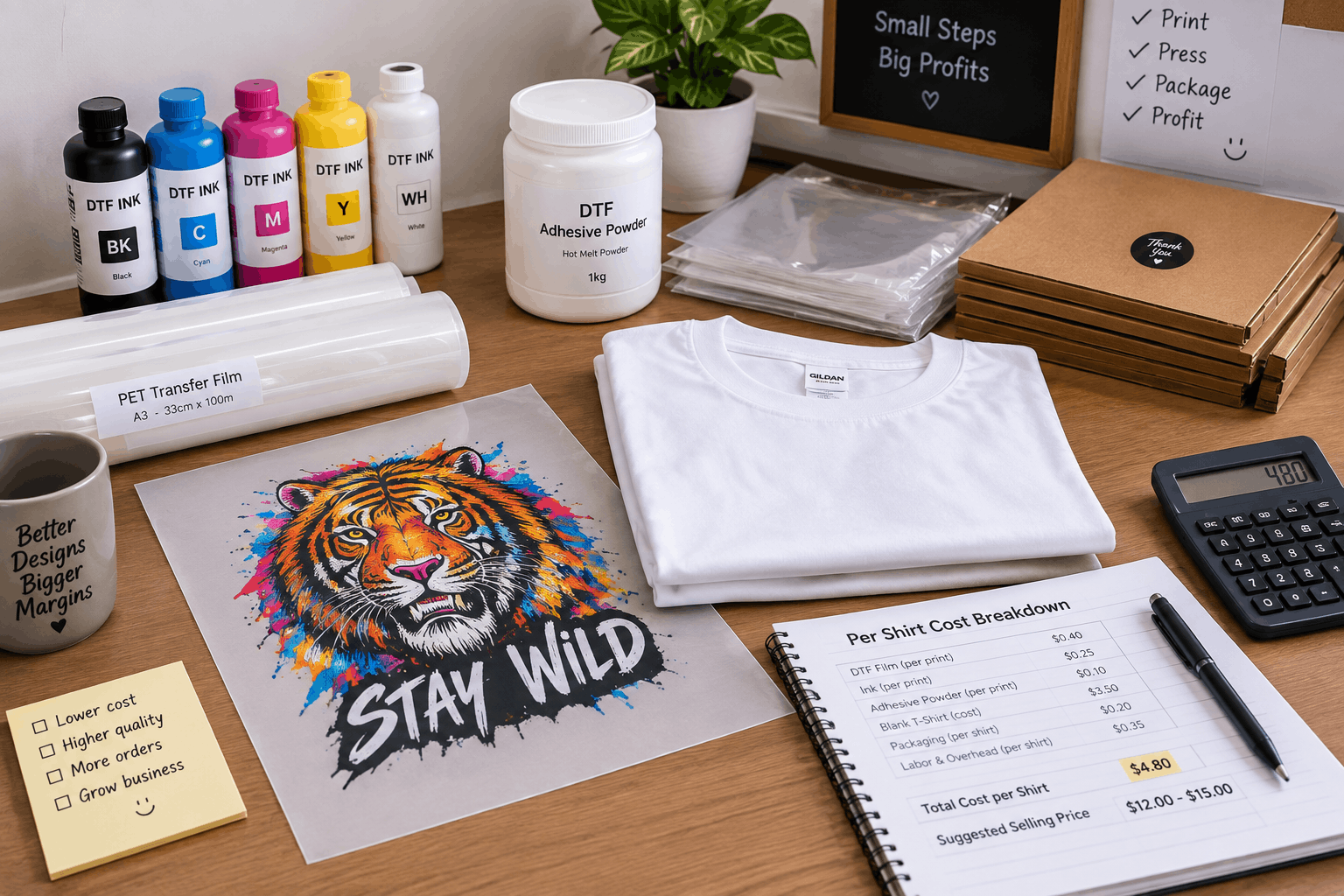
The DTF printing cost per shirt depends on more than the amount of ink used to print a design. A realistic calculation can include transfer film, DTF ink, adhesive powder, the blank garment, labor, electricity, packaging, maintenance, and production waste. Understanding each cost helps a small apparel business price its products without confusing material cost with total production cost.
What Makes Up the Cost of a DTF-Printed Shirt?
A DTF shirt starts with a digital design and ends with a finished garment, but several costs occur between those two points.
The main cost categories are:
- Blank T-shirt or other garment
- DTF transfer film
- DTF ink
- Hot-melt adhesive powder
- Electricity
- Printer and equipment maintenance
- Labor or production time
- Packaging
- Waste and failed transfers
- Business overhead
Not every business will calculate these expenses in exactly the same way. For example, someone printing at home may have lower overhead than a dedicated print shop, while a larger operation may have additional labor, storage, rent, and packaging expenses.
How to Calculate DTF Printing Cost Per Shirt
A simple way to calculate the direct production cost is:
DTF printing cost per shirt = garment cost + transfer materials + production cost + allocated overhead
The exact numbers should come from your own supplier prices, equipment usage, production process, and operating expenses.
For example, imagine a business tracks the following for one shirt:
- Blank garment: $X
- Film and ink: $Y
- Adhesive powder: $Z
- Electricity and production time: $A
- Packaging: $B
The business can add those amounts together to establish its direct cost for that particular order.
This approach is more useful than relying on a generic online figure because DTF production costs can change depending on the design, garment, supplier, print area, and workflow.
Ink Is Only One Part of the Calculation
Ink naturally gets attention when discussing DTF costs, but it should not be treated as the entire printing expense.
A DTF workflow can involve CMYK ink and white ink, with the amount consumed varying according to the artwork and print settings. A design with large areas of solid color can require a different amount of ink from a small logo or simple graphic.
White ink also has an important role in DTF printing because it helps create an opaque foundation for designs applied to colored garments. Proper printer operation and maintenance therefore matter when considering the long-term cost of production.
Instead of asking only, “How much ink does this shirt use?” a better question is, “What does it cost to produce and finish this specific transfer?”
Film and Adhesive Powder Matter Too
DTF transfer film is another direct material cost. The amount used depends partly on how the artwork is arranged on the film and whether several designs can be grouped efficiently.
Adhesive powder is also part of the transfer process. It bonds the printed design to the garment when the transfer is properly cured and heat pressed.
Material efficiency can therefore affect unit economics. If a business wastes unused film, powder, ink, or poorly prepared transfers, its effective cost per successful shirt increases.
That is why tracking successful finished garments rather than simply counting printed transfers can provide a more realistic picture.
The Blank Garment Can Change the Equation
For many apparel businesses, the blank T-shirt is a major part of the final product cost.
Garment prices can vary according to fabric, quality, supplier, size, color, and order quantity. A basic shirt and a premium heavyweight garment should not automatically be treated as having the same production cost.
The same principle applies to other products such as hoodies, tote bags, sweatshirts, and custom apparel.
When calculating your DTF printing cost per shirt, keep the garment cost separate from the transfer-production cost. This makes it easier to compare different products and adjust pricing when supplier costs change.
Labor and Production Time Should Not Be Ignored
A transfer may look inexpensive when you count only consumable materials. However, producing a finished garment can involve several manual steps.
Someone may need to:
- Prepare the artwork.
- Set up the print job.
- Print onto transfer film.
- Apply adhesive powder.
- Cure the transfer.
- Position it on the garment.
- Heat press the design.
- Peel or finish the transfer according to the process.
- Inspect the garment.
- Package the finished order.
For a business owner doing all these tasks personally, it can be tempting to treat the labor as free. However, labor still represents time that could otherwise be spent on sales, customer service, production, or other business activities.
A useful cost calculation should therefore distinguish between material cost and the value of production time.
What About Waste and Failed Transfers?
Waste is easy to overlook because it may not appear on the final product.
A transfer can be wasted because of printing errors, poor film handling, unsuitable artwork, curing problems, positioning mistakes, or problems during pressing. Consumables may also be lost during routine maintenance.
If a business calculates costs only from successful shirts, these losses disappear from the calculation.
A practical solution is to monitor material usage and unsuccessful production over time. The resulting information can then be included as a reasonable operating allowance rather than pretending every unit of material becomes a sellable product.
Equipment Cost and Maintenance
The printer itself is not necessarily a direct cost of every individual shirt, but equipment still has an economic impact.
Maintenance supplies, replacement parts, printhead-related expenses, cleaning materials, and other operating requirements can contribute to the long-term cost of producing transfers.
For businesses deciding whether to purchase equipment, a broader small-business DTF printing perspective can be useful. Looking at printer requirements alongside consumables, maintenance, production volume, and available workspace gives a more complete picture than comparing printer prices alone.
How Should You Use the Cost When Setting a Selling Price?
Production cost and selling price are two different numbers.
Suppose a finished shirt costs a business $X to produce. That does not automatically mean the shirt should be sold for $X plus a fixed percentage. The business may also need to account for marketing, payment processing, packaging, shipping, customer service, taxes, marketplace fees, returns, and other expenses.
A simple pricing process is:
Calculate production cost → add relevant business expenses → determine the desired margin → review the final price against the product and market.
The important point is to know what is actually included in the starting cost.
Common Questions About DTF Shirt Costs
Is DTF printing expensive per shirt?
The answer depends on the garment, design size, ink and material usage, labor, waste, and operating costs. A small design on an inexpensive garment will have a different cost structure from a large full-front design on a premium shirt.
What is the biggest cost in a DTF shirt?
There is no universal answer. The blank garment, transfer materials, labor, and other expenses can each represent a significant portion depending on the business model and product.
Does a larger design cost more to produce?
It can. A larger design may require more film space and potentially more ink and adhesive material. The actual difference depends on the artwork and production settings.
How can a small business reduce DTF costs?
Start by measuring actual usage rather than guessing. Track film, ink, powder, garments, failed transfers, production time, and packaging. Efficient artwork placement and careful workflow can also reduce unnecessary material waste.
Should I calculate every shirt individually?
Not necessarily. Businesses can establish a reasonable average cost for common products while separately tracking unusual jobs. For example, a standard front-print T-shirt can have one baseline cost, while oversized artwork or specialty garments can be calculated separately.
Build Your Cost Model Around Real Production
The most useful DTF cost calculation is the one based on your own workflow. Supplier prices, garment choices, print sizes, production volume, maintenance requirements, and labor arrangements all affect the final number.
Rather than asking only how much a DTF transfer costs, look at the complete journey from blank garment to packaged product. Once those costs are separated and tracked consistently, a small apparel business can make more informed decisions about product pricing, production efficiency, and future equipment needs.